
by Robert Taylor

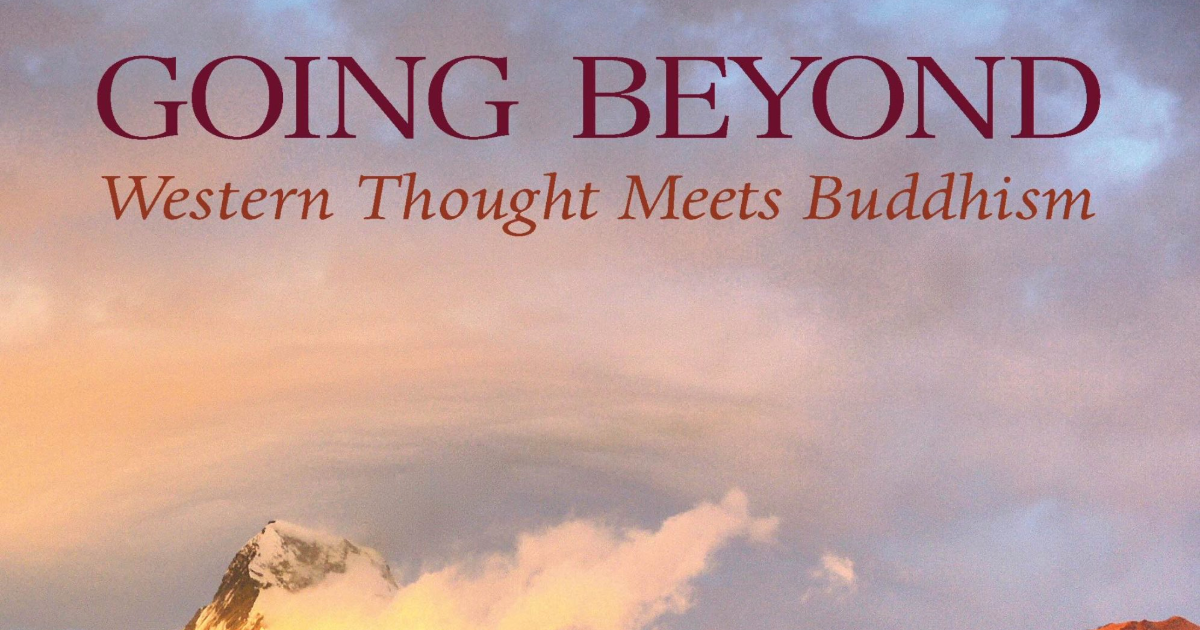
Peter Oldmeadow’s new book, Going Beyond, does something quite remarkable. Through a dialogue between Western philosophy and Buddhism, this work gifts some of Buddhism’s sacred spark into the Western canon.
Oldmeadow achieves several important aims in this book. It contextualises the historical interrelationship of Indian and Western philosophy, particularly through a very engaging account of 19th century European scholarship in Indic studies and their influence on German Romantic philosophy. It then provides an overview of three key figures in the European tradition, Schopenhauer, Nietzsche, and Heidegger, and outlines both their direct engagement with Buddhism, as well as their shared conceptual ground. In its final third the book explores deep ecology, engaged Buddhism, and postmodernism, framing a productive conversation about how Buddhism intersects with our modern philosophical, cultural, and even political contexts.
Oldmeadow’s work enlivens both traditions. The reader is offered a subtle analysis of the Indian and European philosophy, which seeks creative common ground while avoiding overstepping into generalisation or overidentification. Most powerfully, it gives the reader a pathway from the experiential insight of Buddhism into the reflective insights of Western philosophy. This integration illuminates the work of the European philosophers whose work is transmitted primarily via text rather than practice. It gives back to Buddhist thought by pointing towards certain cross-cultural insights, which may be more readily graspable by a Western audience.
In the book’s final section, Oldmeadow invites Western readers to consider how Buddhist insight could fit within our contemporary political, ethical, and spiritual lives. Buddhist thought and practice is presented as a potential anchor within a world of destabilised truths. The insight of interdependence demonstrates an alternative mode of engagement with the world around us, in contrast to technological, extractive, and utilitarian views. Finally, Oldmeadow productively explores Engaged Buddhism, and how its insights can engage with western social activism.
This is an excellent book. While its wide scope means that it serves as an overview or starting point for many of these discussions, it is rigorous, evidenced, and does not seek to impose the author’s views on the reader. Oldmeadow’s work demonstrates that there is immense fertile ground in between these traditions that is relevant and timely. Let us hope for more work of this calibre to continue to deepen our understanding.